Vision loss in dogs rarely arrives with a clean announcement. It usually slips in through small hesitations and tiny detours. A dog that once sprinted across the living room now slows down at the doorway, as if the space has changed. A confident jumper suddenly pauses before the couch. A treat tossed across the kitchen is misjudged, not by an inch, but by a full step. Many owners describe the same quiet feeling: something is different, but it is hard to name. That uncertainty is part of why people ask, “Why do dogs lose their vision?” The phrase sounds like a single problem with a single answer. In reality, it is a category of problems that share one visible outcome. A dog sees less than before. The causes vary widely, and the urgency varies even more. Some conditions progress slowly and painlessly. Others can damage vision in hours and hurt the whole time. Some affect the lens and show up as obvious cloudiness. Others happen deeper inside the eye, where the surface looks normal even as sight fades. Understanding the major reasons dogs lose vision does not turn you into a veterinarian, but it can help you recognize the difference between normal aging changes, chronic disease, and situations where time matters.
A helpful way to think about canine vision loss is to start with the timeline. For many dogs, sight diminishes gradually. Owners tend to notice night trouble first. The dog becomes cautious on evening walks, hesitates in dim hallways, or seems oddly uncertain when shadows stretch across the floor. Gradual changes can feel like personality shifts: less interest in fetch, more clinginess, less enthusiasm for unfamiliar places. Dogs are excellent at adapting, so they compensate long before humans realize anything is wrong. They memorize furniture placement, follow scent trails, and rely on routine. If the loss is slow, they build a new map of the world in real time.
Other dogs lose vision suddenly. This is the version that feels like a crisis because, in some cases, it is. A dog who navigated the house perfectly yesterday begins bumping into the wall today. They startle easily, cling to you, or freeze on the stairs. Sudden vision loss can come from conditions that are painful and destructive, such as glaucoma, or from disorders that affect the retina quickly. The surface of the eye may look red or cloudy, or it may look frustratingly normal. When the change is abrupt, it is not just a “watch and wait” situation. It is a reason to call a veterinarian promptly, because some causes are treatable if caught early and much harder to address if delayed.
One of the most recognized causes of vision loss in dogs is cataracts. Cataracts occur when the lens, the clear structure behind the pupil that helps focus light, becomes opaque. In simple terms, the dog is trying to see through a fogged window. Cataracts can be inherited, age-related, or secondary to another medical condition. Diabetes is a major trigger in dogs, and it is infamous for causing cataracts to develop quickly. When cataracts become mature, they can significantly block light from reaching the retina, leading to notable vision impairment.
Cataracts are also a source of confusion because not all cloudy eyes mean cataracts, and not all cataracts mean immediate blindness. Some cataracts are small and slow-growing. Others progress rapidly. A dog might still navigate familiar spaces fairly well even with developing cataracts, especially in bright light. The key point is that cataracts are a lens problem, and lens problems can sometimes be addressed medically or surgically depending on the case. That is very different from conditions where the retina, the light-sensing tissue at the back of the eye, is failing. In those cases, clearing a cloudy lens does not restore function that the retina can no longer perform.
This is where another common age-related change enters the story: nuclear sclerosis, sometimes called lenticular sclerosis. Many older dogs develop a bluish haze in the lens that owners notice in certain light. Nuclear sclerosis is essentially a normal aging change where the lens becomes denser. It can make the eyes look cloudy, but it is typically not the same as a cataract and usually does not cause severe vision loss. Dogs with nuclear sclerosis may have a mild reduction in sharpness, but they often see well enough to move around normally. The catch is that it is difficult for a pet owner to distinguish nuclear sclerosis from early cataracts by appearance alone. That distinction matters, which is why a veterinary exam is more useful than guessing based on a photo.
If cataracts represent the visible, surface-level clue, progressive retinal atrophy represents the quiet, internal fade. Progressive retinal atrophy, often shortened to PRA, is not one single disease but a group of inherited conditions that cause degeneration of the retina over time. The earliest sign is frequently night blindness. Owners may notice their dog bumping into things only when it is dark, or hesitating in low light. Over months or years, PRA can progress to more significant vision loss and, in many cases, eventual blindness.
PRA has a particular emotional weight because it is often painless. There is no obvious redness or squinting. The dog does not appear uncomfortable. Instead, the dog appears increasingly cautious. They choose familiar routes. They pause at thresholds. They rely more heavily on sound and scent. The human reaction is often delayed grief, followed by guilt, because the dog has been adapting quietly the whole time. The hidden truth is that many dogs cope remarkably well with gradual blindness. Their world is not built on vision alone. It is built on smell, routine, and relationship. That does not make the condition unimportant, but it does change the way you think about quality of life.
Another retinal condition that often enters conversations about sudden blindness is sudden acquired retinal degeneration syndrome, commonly called SARDS. SARDS is known for rapid loss of vision, sometimes over days to weeks. What makes it especially unsettling is that the eyes can look relatively normal early on, even as the dog’s behavior changes dramatically. Dogs may begin bumping into objects, seem disoriented, or grow anxious in spaces they previously trusted. The exact cause of SARDS is not fully understood, and that uncertainty can be hard for owners who want a tidy explanation. Still, the practical reality remains: sudden blindness is a serious symptom, and a veterinarian needs to rule out painful emergencies and other treatable causes.
Among those emergencies, glaucoma stands out. Glaucoma involves increased pressure inside the eye, usually because fluid cannot drain properly. That pressure can damage the optic nerve and retina, and it can do so quickly. It is also typically painful. A dog with acute glaucoma may squint, rub at the eye, avoid being touched near the face, or act unusually lethargic. The eye may appear red, cloudy, enlarged, or swollen. Because glaucoma can lead to rapid and irreversible vision loss, it is treated as urgent. In the context of “Why do dogs lose their vision?” glaucoma is one of the answers that comes with the clearest warning label: do not wait.
Inflammation inside the eye can also interfere with vision. Uveitis, which is inflammation of internal eye structures, can cause pain, redness, squinting, light sensitivity, and cloudiness. Inflammation can be triggered by infection, immune-mediated disease, trauma, or systemic illness. When the eye is inflamed, vision can blur, and if inflammation is severe or chronic, it can lead to complications that further reduce sight, including glaucoma or cataract development. What appears at first like simple irritation can, in some cases, represent a deeper process that needs medical attention.
Trauma is another straightforward pathway to vision loss. A scratch, blunt injury, bite wound, or impact can damage the cornea, lens, retina, or optic nerve. Even if the injury looks superficial, the internal structures may be affected. A dog that suddenly becomes head-shy, squints, or keeps one eye closed after an accident should be evaluated promptly. Eye injuries can worsen quickly, and pain management matters as much as preserving vision.
Then there are conditions where vision loss reflects something going on elsewhere in the body. The eye is not isolated from the rest of the dog. Systemic diseases can contribute to retinal problems, inflammation, or vascular events that compromise sight. High blood pressure can be associated with retinal changes and, in some cases, retinal detachment. Metabolic disorders, infections, and other underlying illnesses can also affect the eye. In these situations, the “why” is not only about the eye itself. It is about the dog’s overall health, with the eye acting as an early alarm.
All of this brings us back to what vision loss looks like at home. Many owners expect blindness to mean constant collisions, but dogs are too skilled at adaptation for that to be the only clue. Instead, the signs can be subtle: bumping into new objects rather than familiar furniture, missing a toy tossed across the room, hesitating at the edge of a step, becoming reluctant to enter dark areas, or appearing anxious in unfamiliar environments. Some dogs startle more easily because their peripheral awareness has changed. Some stop making eye contact, not from aloofness, but because locking onto a face is harder. Others stick closer to their owners as if proximity itself is a form of security.
The challenge is that these behaviors can also overlap with normal aging. Older dogs may slow down, become more cautious, and sleep more. That does not mean you should ignore the possibility of vision change, and it does not mean every hesitation is a crisis. It means you need to pay attention to pattern and progression. Is the behavior new? Is it getting worse? Did it happen suddenly? Does it come with signs of pain such as squinting, rubbing, redness, or discharge? Those details are often more meaningful than a single moment of clumsiness.
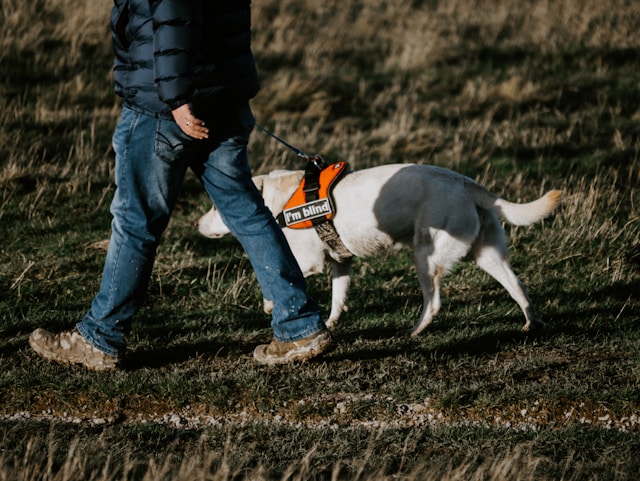
It is also worth addressing the part that owners rarely say out loud: people often handle a dog’s vision loss worse than the dog does. Humans are visual creatures. We imagine the world collapsing without sight. Dogs live in a different sensory hierarchy. Smell is not a bonus sense for them, it is a primary way of understanding. Sound and routine fill in the gaps. A dog who loses vision can still recognize you by footsteps, still find the treat drawer by scent, still do the pre-walk dance when they hear the leash, still move confidently through a familiar home. That does not erase the loss, but it reframes it. Blindness is not automatically a sentence to a diminished life. It is a shift in how a dog navigates, and many adapt beautifully when their environment stays consistent and their humans stay calm.
At the same time, optimism should not replace action. The reason professional diagnosis matters is that different causes of vision loss can look similar to a non-specialist. A cloudy lens can be a cataract or a normal aging change. A dog bumping into furniture can be gradual retinal degeneration, sudden retinal syndrome, pain from pressure, or even a systemic illness affecting the eyes. Some causes are reversible or treatable, especially when caught early. Others are progressive, and the goal becomes slowing change, managing comfort, and helping the dog adapt. The only way to know which story you are living is to get an exam.
So why do dogs lose their vision? They lose it for many reasons, and those reasons live in different parts of the eye and different parts of the body. The lens can cloud with cataracts, sometimes related to genetics, age, or diabetes. The lens can also change with age in ways that look dramatic but are often mild. The retina can slowly degenerate in inherited conditions like PRA, beginning with night blindness and progressing over time. The retina can also fail suddenly in conditions like SARDS. Pressure inside the eye can rise dangerously in glaucoma, causing pain and rapid damage. Inflammation, trauma, and systemic disease can compromise the eye’s delicate structures and blood supply. The shared outcome is that a dog sees less, but the path to that outcome is not the same.
If your dog is showing signs that worry you, the most important takeaway is not to memorize every condition. It is to respect the timeline and the presence of pain. Gradual changes deserve attention and a veterinary conversation, especially if they are progressing. Sudden changes deserve urgency. Painful eyes deserve immediate care. And in the space between your worry and the appointment, it helps to remember that dogs are not defined by vision. They are defined by trust, routine, and the way they lean toward you in the doorway when the room feels unfamiliar. Keeping their world stable while professionals handle the medical side is often the most powerful thing you can do.
 WhatsApp
 Instagram
 Threads