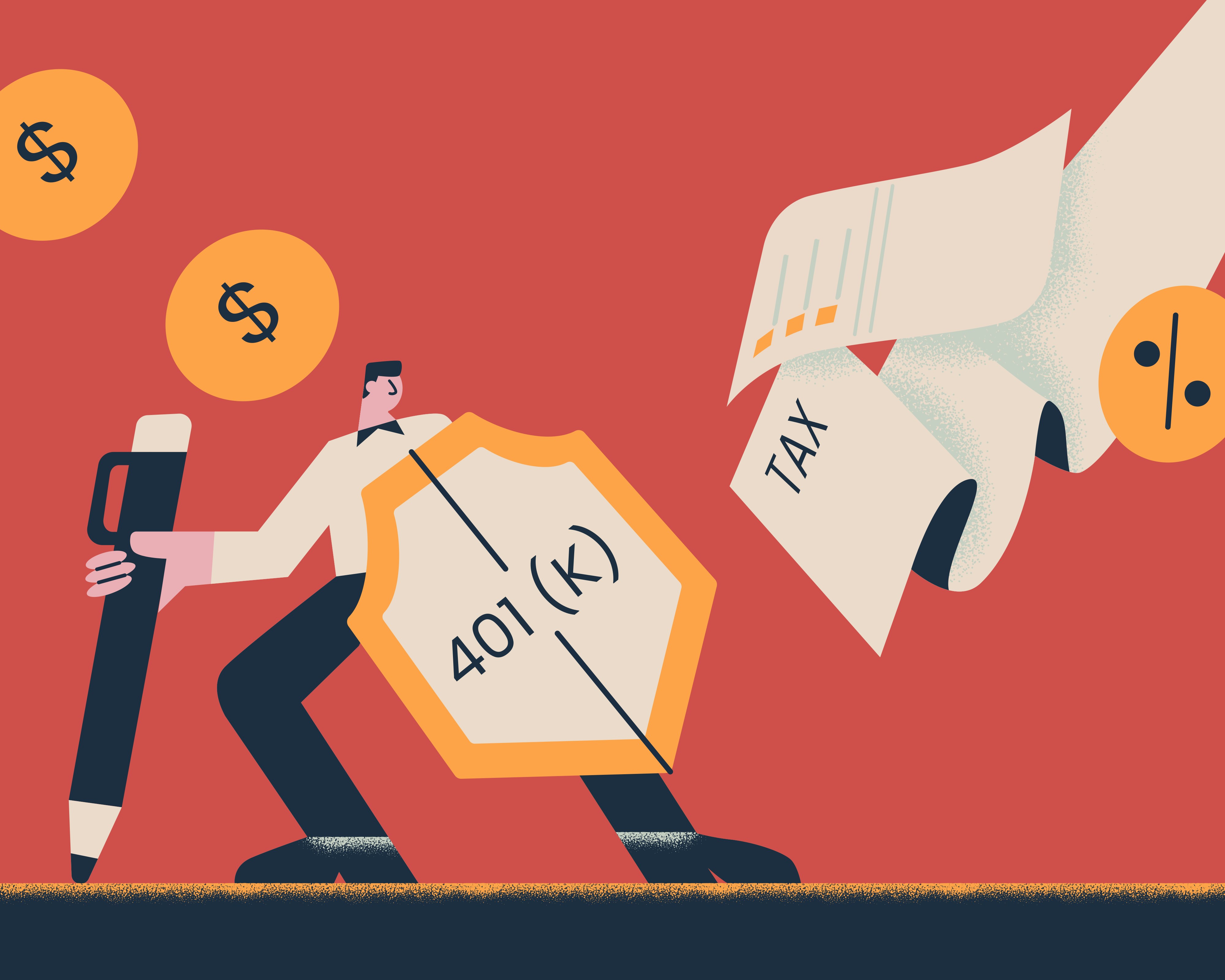
For many employees in the United States, a 401(k) lives quietly in the background of their financial life. Contributions go out of each paycheck before the money even reaches their bank account. A default fund might have been chosen during onboarding, and after that, the account is often forgotten except for the occasional glance at a quarterly statement. Yet beneath that ordinary surface, a 401(k) can be one of the most powerful tools for building long term wealth, especially when it is used deliberately and anchored within a broader plan for retirement and financial independence.
The strength of a 401(k) begins with its structure. Unlike a standard investment account, most traditional 401(k) contributions go in before income tax is applied. That allows you to invest a larger slice of every dollar you earn compared with putting the same money into a taxable brokerage account. Tax that would have gone to the government immediately is instead given time to grow. You will eventually pay tax on withdrawals in retirement, but all the growth along the way has taken place on a bigger starting amount. Over decades, that difference creates a meaningful gap between someone who uses a 401(k) consistently and someone who saves only in fully taxable accounts.
On top of that, many employers contribute their own money to your account through an employer match. This is not a casual perk. It is a formal part of your compensation, tied directly to your decision to participate. When an employer agrees to match your contributions up to a certain percentage of your salary, they are effectively offering you additional pay that is funneled straight into your long term wealth. Failing to contribute enough to receive the full match is very similar to turning down a portion of your income. When you stretch this out over ten, twenty, or thirty years, employer contributions can grow into a substantial portion of your retirement savings, sometimes rivaling what you put in yourself.
Automation is another quiet advantage. Once you choose a contribution rate, the system runs on its own. You do not need to remember to make a transfer every month, argue with yourself about spending versus saving, or battle decision fatigue. The money is invested before you get the chance to use it elsewhere. That automation matters because the biggest difference between people who reach their retirement goals and those who do not is often not investment skill, but consistency. A 401(k) helps remove the need for repeated discipline by embedding the habit into the payroll process.
These structural features become even more powerful once you add time. Imagine starting in your late twenties or early thirties and contributing steadily until your early or mid sixties. That is roughly three decades of contributions, followed by possibly three more decades of withdrawals in retirement. Even moderate returns, when compounded over such a long horizon, can transform what looks like small monthly amounts into a substantial nest egg. In the early years, your balance may feel insignificant next to your salary or living costs, and it may be tempting to dismiss the impact of a few hundred dollars each month. Over time, however, your contributions and the earnings on those contributions begin to reinforce one another. Growth in your thirties becomes the foundation for further growth in your forties and fifties.
This is why seemingly small changes in your contribution rate matter. Increasing your saving from 5 percent of your salary to 8 percent may not feel dramatic in the short term, especially if you phase in the increase around raises or bonuses. Yet across thirty years, the extra contributions, combined with investment returns and employer matches, can translate into hundreds of thousands of additional dollars by the time you retire. The curve of your account balance is rarely smooth, because markets move up and down, but the long term trajectory can still be strongly upward if you stay invested and keep adding to your account.
The tax story around a 401(k) also influences your flexibility later in life. Traditional 401(k) contributions are generally tax deferred, which means you receive a tax benefit now and pay ordinary income tax when you withdraw money in retirement. Many employers also offer a Roth 401(k) option, where contributions are made with after tax dollars, but qualified withdrawals in retirement are tax free. In both cases, you are using the tax system to shape not only how much you save, but also how your future tax bill will look across your later years.
Choosing between traditional and Roth contributions, or deciding on a mix of the two, depends on several factors. Your current tax bracket, your expectations about your income in retirement, and the presence of other accounts such as taxable brokerage accounts or pensions all play a role. For example, someone in a high tax bracket today who expects to be in a lower bracket later might lean more heavily toward traditional contributions. Someone earlier in their career, currently in a lower bracket but expecting higher earnings in the future, might find Roth contributions especially valuable. The key is not to chase perfection, but to be conscious of the choices you are making and how they affect your later spending power.
For people who may move countries or return to a home country after working in the United States, tax considerations become more complex, as different jurisdictions treat retirement accounts differently. Even then, the underlying benefit of long term, tax advantaged growth remains. The main difference is that you need to understand how withdrawals will be taxed in your destination country and whether any tax treaties apply, so that you can plan your eventual drawdown in a deliberate way.
Given how valuable employer matching contributions are, they are often a natural starting point when you design a savings plan. A simple first target is to contribute at least enough of your salary to capture the full match. If your employer matches, for instance, up to 4 or 5 percent of your salary, hitting that threshold should be treated as a minimum rather than an aspirational goal. Once you are consistently receiving the full match, you can think about increasing your contributions gradually. Each time your salary rises, you can direct a portion of the raise into your 401(k). Since that additional money was never part of your prior take home pay, you may not feel as much of a squeeze, while your long term savings rate improves.
It is also sensible to check how your employer’s contributions vest. Some companies require you to stay for a certain number of years before the employer match fully belongs to you. Understanding that timeline helps when you are weighing a job change. You may still decide that a move is right for your career or your family, but you will be making that decision with clear information about what you are leaving behind in unvested benefits and whether the new role adequately compensates for that loss.
Inside the 401(k) itself, you will usually find a menu of investment options, often a mix of mutual funds or exchange traded funds that cover different sectors and asset classes. Many plans include target date funds designed for people who expect to retire around a particular year. These funds automatically adjust the balance between growth oriented assets such as equities and more conservative assets such as bonds as you age. For someone who does not want to manage the portfolio directly, a target date fund can be a straightforward choice, as long as you pick a year that roughly aligns with your planned retirement horizon.
If you prefer to build your own allocation, it helps to think about your investments in simple categories. Equities usually drive long term growth, bonds provide stability and income, and cash like holdings sit at the very conservative end, protecting value but offering little growth. The right mix depends on your age, your comfort with seeing account values fluctuate, and how much savings you have elsewhere. One practical way to gauge your tolerance is to recall how you felt and behaved during past market declines. If you know that sharp drops make you anxious and prone to panic selling, it may be better to adopt a somewhat more conservative allocation than a textbook chart suggests, so that you can stick with your strategy over time.
From a behavioral standpoint, the workplace structure around a 401(k) is one of its greatest advantages. The account reduces the number of decisions you have to make. Contributions happen automatically. You can schedule rebalancing annually or semi annually. You are not prompted to trade frequently or chase trends. This insulation matters because emotional reactions to market news, social media, or economic headlines often lead investors to buy high and sell low. With a well diversified 401(k) portfolio, your main job is to maintain alignment with your long term plan rather than to respond to every piece of short term information.
Many employers further support this by offering automatic escalation features. Under such a program, your contribution rate increases by a small amount each year, often at the same time as your annual raise. If you opt in and choose a reasonable target rate, this slowly nudges your savings level upward without requiring you to revisit the decision every few months. Over several years, you might move from a modest contribution rate to a robust one with relatively little friction.
Modern careers often involve several job changes, and this introduces another important aspect of using a 401(k) wisely. Each time you leave an employer, you must decide what to do with the existing account. The main options are to leave the money in the old plan, roll it into your new employer’s plan, move it into an individual retirement account, or take a cash distribution. From a wealth building perspective, cashing out is usually the least helpful path. Withdrawals before a certain age typically trigger both income tax and an early withdrawal penalty. More importantly, you break the compounding process and remove money from a tax advantaged environment, which can create a long term shortfall that is difficult to repair.
Rolling your old 401(k) into a new plan or into an individual retirement account keeps your savings working for you. It can also simplify your financial life by consolidating multiple accounts and giving you a clearer view of your total retirement picture. Leaving the account where it is can be acceptable if the old plan offers strong investment options and low fees, but in that case you need to remember to include it in your planning rather than mentally misplacing it as a forgotten account.
To use a 401(k) well, it helps to place it within a broader framework for your finances. One way to think about this is in layers. The first layer is your near term safety net, such as an emergency fund and cash savings for known upcoming expenses. The second layer is your long horizon retirement base, where your 401(k) usually belongs as a core component. The third layer is flexible investing outside retirement accounts, which supports goals like early financial freedom, property purchases, funding education, or helping family members. If you focus solely on your retirement account without maintaining a buffer and flexible capital, you may feel locked in and unable to handle life’s twists. If you ignore the retirement layer and focus only on immediate and flexible goals, you risk reaching your later years without a strong foundation.
In this context, 401(k) accounts for long term wealth play a crucial role. They provide a disciplined, automated way to accumulate assets, benefit from employer contributions, and harness the power of compounding over decades. They also give you levers to manage your future tax situation, which in turn can influence how freely you can travel, move, or change your lifestyle when full time work is behind you. When you treat your 401(k) as a deliberate part of a multi layer plan rather than as a passive default, it becomes much more than a line in your HR portal.
It can be helpful to check in with yourself periodically and ask some concrete questions. Are you receiving the full employer match available to you, and if not, what changes would allow you to reach that level. Do you understand the broad composition of your investments inside the plan and how much of your portfolio is in equities, bonds, and cash like holdings. Are the fees on your chosen funds reasonable, or are there lower cost options that provide similar exposure. Do you have a plan for what will happen to your 401(k) when you next change jobs.
A 401(k) will rarely be the most exciting item in your financial life. It will not demand daily attention or want to be talked about in social settings. Yet that quiet, almost invisible quality is part of its strength. While you focus on your career, your family, and your personal goals, your workplace retirement plan continues to do its patient work in the background. You do not need to chase every market move or design a complex strategy. You need a clear contribution plan, sensible investments, and the discipline to leave the structure in place.
When you use a 401(k) in this way, it becomes a steady engine for long term wealth building. It gives you a stable base under your future, so that the choices you make later in life are guided more by what you want your time to look like and less by fear of running out of money. In that sense, the real value of a 401(k) is not just in the numbers on a statement, but in the confidence and flexibility it can offer when work slows down and the next chapter of your life begins.
 WhatsApp
 Instagram
 Threads